
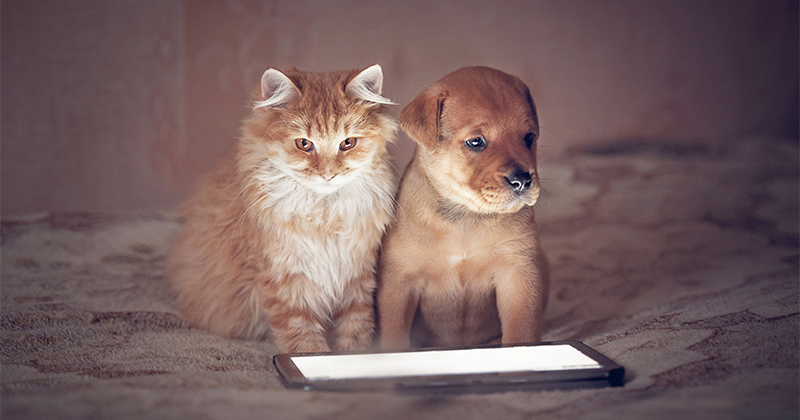
Unconventional Communication: What Your Pets Are Trying To Tell You
Our furry and feathered companions give us unconditional love. At least, we think they do. Wouldn’t be a lot easier if they could tell you that for themselves?
Although you may think that dialogue with your domesticated darlings is one way, your pets can talk. They just don’t use words. Here’s how to listen to what your pets are really trying to say in their own way.
Dogs: Dear Human, Watch My Tail.
Our beloved pups use their tails to talk to us. A very erect tail with a little wag does not mean your dog is happy. It is actually their way of saying I’m scared or worried. The, “oh my gosh, I’m so happy” wag is big and bold. It’s the wag where their whole body shakes! When your dog is extra joyful, they will start to spin in circles while they are wagging their tails.
Guinea Pigs: I’m Squeaking To You.
These furballs are rather vocal and use a mixture of sounds and body language to express their feelings.
That noise that sounds a bit like a metal detector is your Guinea pig’s way of saying he is excited. You’ll probably notice this happens around feeding or play time. A hiss or something charring their teeth means, “stay away, I’m angry.” Much like a cat, your piggy can purr too. But not all purrs are happy ones. Your lil’ guy is content when the purr is deep and relaxed. If the purr is high-pitched, he’s annoyed.
Cats: Dead Tidings.
All cat owners know the ‘joy’ of finding birds, mice and all manner of other critters left to waste around the house. Don’t be alarmed, your faithful feline is not leaving you a death threat. In fact, they are showing true love.
In the wild cats, bring food to their kittens to feed them. Cats think we are rather useless hunters as we can’t catch our own food. Their bringing in dead creatures is their way of saying that they don’t want you to starve, so they lend a helping paw.
Rabbits: I’m So Hoppy You’re Mine.
Pet rabbits are fast becoming commonplace. These tiny creatures will try their best to jump up on to a couch (not an easy thing to do if you’re a bunny) just to say, “Hi I love you,” or “What are you doing?”
Just like us humans, Rabbits will also grunt when they are displeased. It’s best to back off and give hoppy some space if they do. Tooth-grinding indicates stress or pain. This is an alert that you need to contact your vet. Don’t confuse this with the clicking sound that they make with their teeth. The clicking actually means that they are happy.
When you get a chin rub, called chinning, you are all theirs. Rabbits have scent glands under their chins, rubbing something with the underside of their chin is how they mark their territory.
Birds: Watch My Tail Feathers.
If you’re lucky enough to own a talking bird, then you are one of the few people who will actually hear your pet say, “I love you.” And they mean it. Your pet bird is not just copying words they hear —they understand emotion.
Even if your bird is not a talker per se, they use noises to signal certain things to their humans. The typical singing, whistling and chirping are all signs of contentment. Loud chattering is an effective way of getting attention when they want you to spend more time with them. Growling is a sign of aggression. Sometimes you might not hear an outright growl, but more of a deep purr. This can also mean your bird is agitated.
Like dogs, birds’ tails talk too. Birds will flip or wag their tail feathers to show affection towards their human. Fanning, however, can be a show of strength when they feel threatened.
Dr Dolittle.
Pet communication has been studied for as long as we’ve been domesticating animals. While heaps has already been uncovered, we’re learning more each day. Scientists are even working on technology that will convert animal’s brainwaves into speech. Who knows…maybe we won’t have to interpret body language for much longer!


