
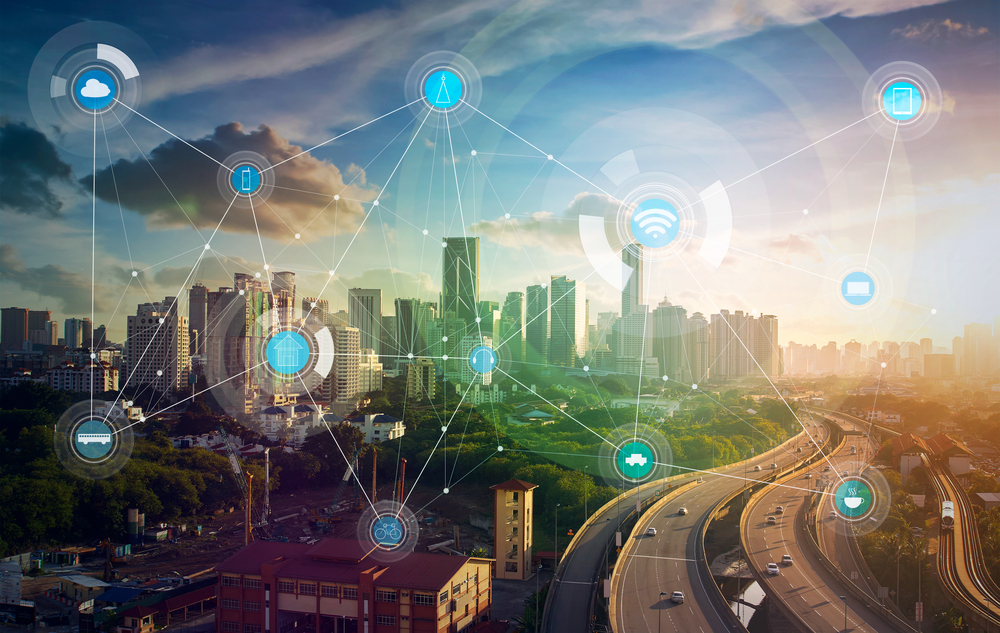
Smart Cities are evolving through the integration of all dimensions of human intelligence, collective intelligence, and also artificial intelligence within the city. The intelligence of cities is an increasingly effective combination of digital telecommunication networks, ubiquitously embedded intelligence, sensors and tags, and software. However, it is important to note that technological propagation is not an end in itself, but only a means to reinventing cities for a new economy and society.
A Smart City can be defined as an urban area that manages assets, resources and services efficiently by collecting data through different types of electronic Internet of Things (IoT) sensors. Data is collected from citizens, devices, and assets which is then analysed and interpreted to monitor and manage, for example, traffic and transportation systems, power plants, utilities, water supply networks, waste management, crime detection information systems, schools, libraries, hospitals, and other community services. The integration of information and communication technology (ICT), and various physical devices connected to the IoT network optimise the efficiency of a city’s operations and services and connect to citizens.
Cities are thus becoming smarter by producing greater public-sector efficiencies through sensors, IoT, LTE (Long-Term Evolution) connectivity, and data analysis. ICT is thus used to enhance quality, performance and interactivity of urban services, to reduce costs and resource consumption, to increase contact between citizens and government, and to improve citizens’ quality of life. However, the specifics of the term itself remain unclear and is open to many interpretations.
How Cities are improving with Network Connectivity.
Major technological, economic and environmental changes have generated interest in smart cities, including climate change, economic restructuring, the move to online retail and entertainment, ageing populations, urban population growth and pressures on public finances.
It is critical that cities have constant network uptime to use central, remote management and fast software updates to bring multiple networks together. It is also essential that advanced security, with stateful firewall and fully encrypted sensitive data are utilised. For example, Page, a city in Arizona in the USA make use of wired and 4G LTE cellular connectivity for WAN routing (wide area network – a telecommunications network that extends over a large geographical area) and Wi-Fi connectivity for the LAN (Local Area Network) and the city’s police vehicles have reliable 4G LTE access from any location. By using SD-Perimeter services for a secure encrypted overlay network, the city network stays hidden from anyone not invited to the network as well as visibility into and control of devices that live beyond the routers. Rather than using VPNs (Virtual Private Network), the city hall, fire department and other departments are connected seamlessly to a Virtual Cloud Network.
Software Defined Perimeter (SDP), also referred to as “Black Cloud”, is a form of computer security which is based on a need-to-know model. Device posture and identity are verified before access to application infrastructure is granted. Application infrastructure is effectually “black”, (a Department of Defence term indicating that the infrastructure cannot be detected), without visible DNS (Domain Name System) information or IP addresses.
Smart applications manage assets & resources efficiently.
Smart applications are utilised to minimise the use of resources, avoid wastage, and reduce overall costs. These Smart applications are, for example, used to: monitor and manipulate water levels remotely and wirelessly; conserve energy and utility resources through smart energy grids; and manage the collection, sorting, and disposal of trash by deploying wireless technologies. Additionally, with mobile connectivity, first responders can react faster and ensure reliable communications to protect their communities and health care providers can track patient’s health conditions more effectively.
Cities using sensors and 4G LTE wireless connectivity add benefits to citizens including reducing traffic congestion; effective parking systems and alerts about vehicle locations, engine diagnostics, idle time, and fuel levels. Additionally, data can be collected to exploit information for more accurate planning and help to drive tourism. Customer experiences can be increased by using more connections at parks and recreation areas through digital signage
A Smart City thus possesses ICT technology in particular areas, and implements this technology in a manner to enhance citizen experiences and impact a local community positively. The use of ICT transforms life and working environments within the region. However, choosing the right solutions for a city’s needs is key in keeping up with the change of technology and citizens’ expectations.
Specifically, 4G LTE wireless connectivity and IoT innovations provide a more cost-effective and efficient network and allow for easier scaling for future network changes. This can be achieved by embedding Communications Technologies (ICTs) in government systems.


